BD Radar: How UK Recruiters Find Hiring Signals Before Jobs Are Posted

When a role hits LinkedIn, you're already late.
By the time a hiring manager publishes the job, they've been thinking about it for six weeks. They've talked to two recruiters in their network. They've considered three of their existing candidate pipelines. The recruiters who win in 2026 aren't the ones who reply fastest to LinkedIn posts. They're the ones who get to the hiring manager before the post exists.
This guide is the category-defining playbook for that. The four hiring signals that predict a role 30-90 days before it's advertised, how to read each one, the underlying math (a £10-50M Series B funding round produces 8-15 hires within 90 days, with predictable function weighting), and how to systematise the whole thing into a 30-minute daily routine that compounds.
Short answer up top: the recruiters consistently winning new clients in 2026 aren't sending more cold emails. They're sending the right cold emails — to the companies that are 30-90 days away from hiring, before any of the obvious LinkedIn intent signals fire. That's what BD Radar is.
We'll get into the detail.
The category nobody named (yet)
There's a clean fork in the UK recruitment market right now between two approaches to business development.
Approach 1: "More emails." Send more cold emails. Use a sequencer. Track open rates. Personalise the first line. This is the approach most BD tools (Paiger, Lemlist, generic sales engagement platforms) are built around. It scales activity, not insight.
Approach 2: Signal intelligence. Send fewer messages, but to companies that are 30-90 days away from a hire. The unit of work shifts from "how many emails per day" to "how many high-intent signals per day."
The first approach treats recruitment BD like sales BD — pipeline by volume. The second treats it like the relationship-led craft it actually is — pipeline by timing.
Why "more emails" stopped working in 2024
Three things broke the "more emails" approach in the last 24 months:
- Volume saturated. Every hiring manager in a target persona was receiving 30-50 recruiter cold messages a month by 2024. The marginal reply rate fell off a cliff.
- AI made personalisation cheap. When everyone can mail-merge a "I noticed your recent [Crunchbase headline]" opener, the opener stops working.
- Timing became the differentiator. The few messages that did get replies were almost always sent to companies that had a hiring need within 14 days. The other 95% bounced.
A 5-person UK recruitment agency that runs "more emails" in 2026 typically gets a 0.3-0.8% reply rate. The same agency, sending half the volume but only to signal-matched targets, gets 3-7% reply rates. Same person. Same writing ability. Different timing.
What signal intelligence actually is
Signal intelligence is the discipline of identifying leading indicators of hiring intent. It rests on three observations about how hiring actually works inside companies:
- Hiring is preceded by external signals. A company doesn't suddenly need a senior engineer on a Tuesday. There's a funding round, an org change, a strategic decision — usually weeks earlier.
- External signals are observable. Funding rounds are public. Executive hires are public (LinkedIn). Senior departures are public (LinkedIn). Job posting velocity is public.
- External signals are predictable in their consequences. A £10-50M Series B is followed by a specific hiring pattern in a specific time window. A VP-level hire is followed by a specific kind of org expansion.
If you watch the signals and know the patterns, you can predict roles 30-90 days before they're advertised.
The difference between BD tools (faster Rolodex) and BD intelligence (different category)
This matters because most "BD tools" sold to UK recruiters are actually contact databases or sequencers. They help you contact more people, faster. That's a faster Rolodex.
BD intelligence is a different category. It's about knowing which people to contact and when. The action is downstream of the insight — the tool starts by surfacing the insight, then helps you act on it.
A real recruiting CRM in 2026 includes a BD intelligence layer, not just a BD activity layer. For the broader context, see what a real recruiting CRM does.
The 4 hiring signals that predict a role before it's posted
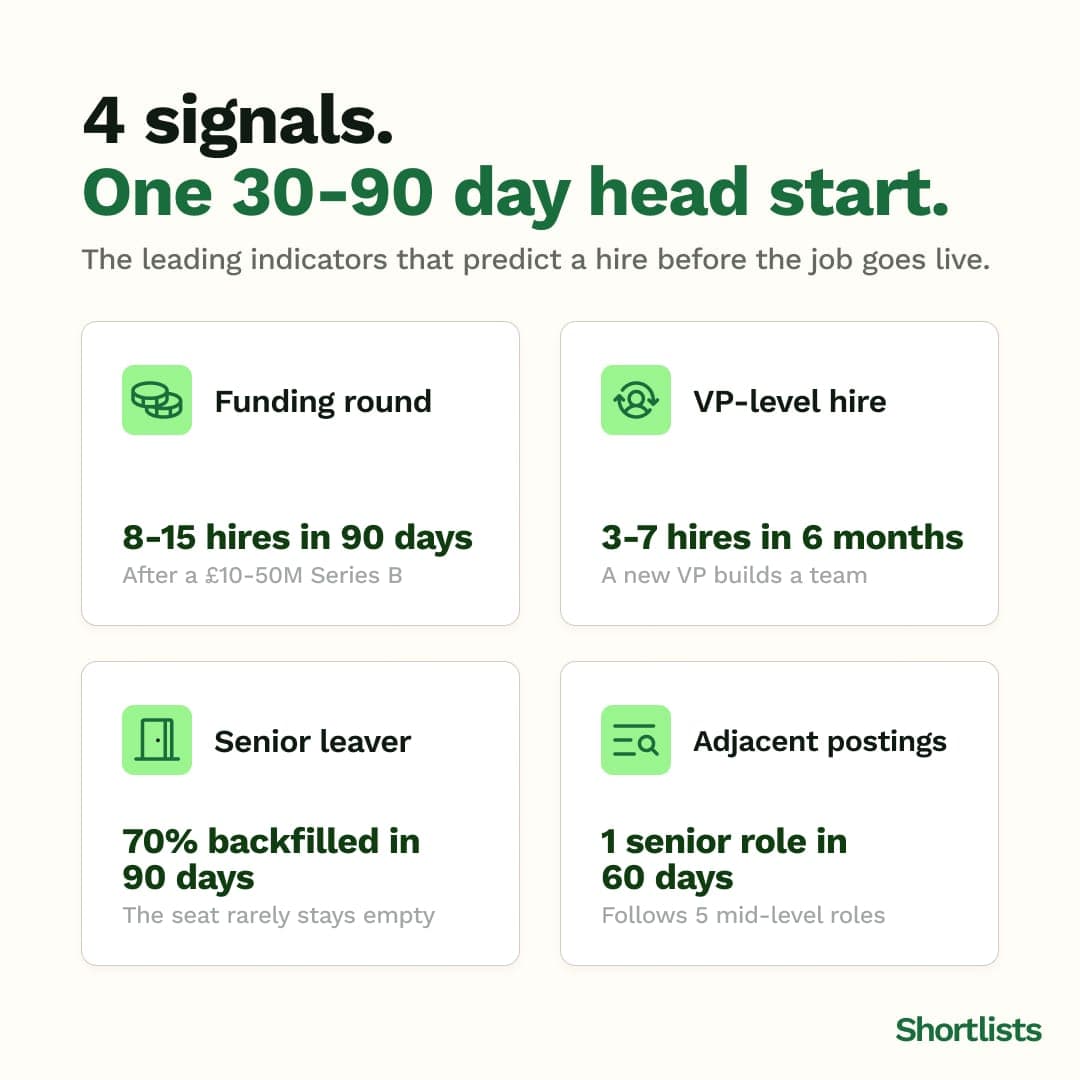
Strip the marketing language out and there are four signals that account for ~85% of all "predicted hire" events in our experience. Some recruiters track all four. Most track one or two. The ones who track all four win consistently.
Signal 1 — Funding rounds (the most predictable)
A company raises money. They tell the press. They tell the board they're going to deploy the capital. Roughly 60-70% of that deployment is people.
The math is consistent across thousands of UK-rooted funding rounds. We'll get into the specifics shortly.
Signal 2 — VP-level executive hires
A company hires a new VP of Engineering, VP of Sales, VP of Product. That VP arrives with a mandate. The mandate is almost always to scale their function. Scaling means hiring.
A new VP brings 3-7 hires in their first 6 months, on average, with the heaviest concentration in months 2-4. Recruit-the-VP becomes recruit-the-VP's-team.
Signal 3 — Senior leavers (the role behind the role)
A senior person leaves a company. 70% of senior departures are backfilled within 90 days. The backfill role is rarely posted immediately — there's typically a 30-60 day internal process first.
If you spot the departure within a week, you're 50+ days ahead of the public posting.
Signal 4 — Adjacent role posting volume
A company posts 5 mid-level engineers in a month. That's a leading indicator of a senior engineer or engineering manager role 60 days out. Mid-level expansion almost always precedes senior-level role creation in scaling functions.
This is the most overlooked signal in the framework. It's also the most automatable.
Signal 1 in depth — Funding rounds
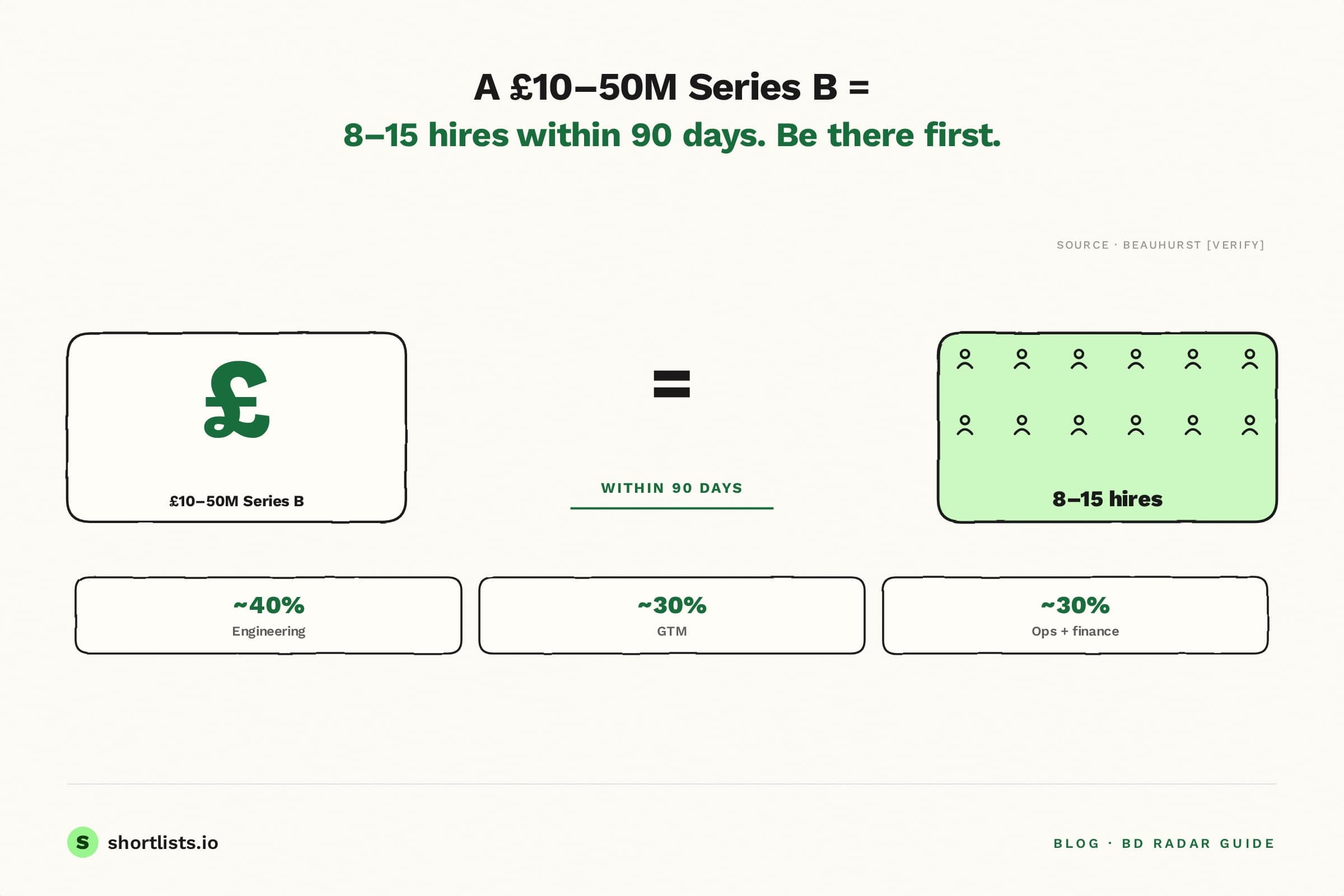
The £10-50M Series B = 8-15 hires within 90 days math
The math, based on UK-rooted funding rounds observed over the past 36 months:
- £5-10M (Seed extension / early Series A): 3-7 hires within 90 days. Heavily engineering + 1-2 GTM hires.
- £10-50M (Series B): 8-15 hires within 90 days. ~40% engineering, ~30% GTM, ~30% ops + finance.
- £50-150M (late-stage): 25-50 hires within 90 days, with continued hiring through 12-18 months. More balanced function mix.
- £150M+ (growth / pre-IPO): Hiring waves rather than discrete spikes. Different signal — track quarterly board announcements instead.
The Series B band is the sweet spot for boutique UK recruitment agencies. The hiring is substantial enough to matter, focused enough to specialise into, and small enough that one strong agency relationship can win 30-50% of the briefs.
Where to find funding data
- Beauhurst — best UK coverage. Tracks all UK Companies House-registered companies with funding events. Free tier is limited; paid tier is worth it for any UK BD operation.
- Crunchbase — better international coverage, weaker on smaller UK rounds.
- Pitchbook — comprehensive but priced for VCs, not boutique agencies.
- TechCrunch UK / Sifted — fastest signal for newsworthy rounds, but only catches the publicised top ~30%.
A practical setup: Beauhurst paid subscription for the comprehensive view, plus a Sifted newsletter subscription for the headlines, plus Google Alerts on your target client names for the rounds that don't get press.
How to filter for actually-relevant funding events
Not every funding round is a signal you should act on. Filter by:
- Sector match. If you specialise in fintech recruiting, a renewable energy raise is noise.
- Geography. UK-rooted companies with UK hiring. Don't waste energy on US-rounds with no UK team.
- Round size. Your sweet spot is usually £5-50M. Below that, hiring is too sparse. Above that, you're competing with established enterprise recruiters.
- Stage of company. Series A/B/C is usually the active band. Seed is too early for substantial hiring; late-stage is usually held by incumbent recruiters.
A well-filtered Beauhurst feed produces ~5-15 high-intent funding signals per week for a typical UK boutique. Manageable.
The first message — what works after a funding announcement
The cold message after a funding round is the most replied-to recruitment message in 2026. Two principles:
- Don't congratulate. Everyone congratulates. "Saw you raised — congrats!" is invisible.
- Lead with the hiring math. "Series Bs of your size usually produce 8-15 hires in 90 days. Which functions are you scaling first?" — opens a conversation, not a pitch.
Done well, this single message format produces 5-10% reply rates from UK Series B founders. For the full deep-dive, see how funding predicts hiring.
Signal 2 in depth — VP-level executive hires
A new VP joining a company is a high-confidence hiring signal — but the timing rule is the opposite of what most recruiters assume.
A new VP brings 3-7 hires in their first 6 months
Reliable pattern. A VP of Engineering arrives, takes 4-8 weeks to assess the team, then begins hiring. A VP of Sales arrives, takes 6-10 weeks to set the GTM, then begins hiring. A VP of Product arrives, takes 6-12 weeks, then hires.
The heaviest hiring window is months 2-4 of their tenure. Outreach in week 1 is too early; outreach in month 6 is too late.
How to track senior moves
- LinkedIn movement notifications. Set "started a new position as VP/Director" alerts on your target accounts.
- Sales Navigator or equivalent. Saved leads with role-change alerts.
- News + announcement scraping. Most VP moves come with a LinkedIn announcement post within 7 days.
A boutique UK agency can comfortably track 200-400 target accounts for VP-level moves with 30 minutes of setup and 5 minutes of weekly review.
When to reach out
Week 2-4 of the new VP's tenure. They're past onboarding, into mandate-execution, but before they've already engaged 3 other recruiters. The opening message should reference their mandate, not their move ("noticed you joined as VP — congrats!" lands worse than "your hiring plan for next quarter, in 5 minutes?").
Signal 3 in depth — Senior leavers
The "role behind the role" framework. Most recruiters chase the role being posted. The signal-aware recruiter chases the role being vacated.
70% of senior departures = a backfill within 90 days
Of senior departures (Director-level and above) at UK companies in the 50-1000 person band, roughly 70% are backfilled within 90 days. About 20% become permanent eliminations (org change). About 10% are filled by internal promotion (which often opens a more junior backfill anyway).
The 70% is your target.
How to track senior departures
- LinkedIn "left their position" notifications on target accounts.
- Endorsement/profile-change patterns — senior people often update their LinkedIn before announcing the departure.
- Industry whisper networks — sometimes the most useful signal source. Senior moves leak before they're public.
The role behind the role framework
When a Head of Engineering leaves, the immediate role to fill is Head of Engineering. But the secondary effect is often more interesting:
- The new Head of Engineering, once hired, will reshape the team.
- That reshape produces 2-5 mid-level engineer roles within 90 days of their start.
- The really sharp recruiter tracks the senior departure and positions for the secondary roles, not just the headline backfill.
Signal 4 in depth — Adjacent role posting volume
The most overlooked signal. Also the most automatable.
When a company posts 5 mid-level engineers, the senior role is 60 days out
If you watch a company's job board, you'll often see clusters of mid-level role postings before a senior role. Patterns:
- 5+ mid-level engineer posts in a month → senior engineer / engineering manager role within 60 days. The mid-level expansion creates the management need.
- 3+ AE / SDR posts in a month → Sales Director or Sales Manager role within 90 days. GTM scaling drives management role creation.
- 2+ designer or product designer posts in a quarter → Head of Design role within 90 days, especially in companies passing 30 employees.
These patterns are remarkably consistent across UK-rooted scaling companies in the 50-300 person band.
How to monitor posting velocity by company + function
- LinkedIn job page tracking for target accounts.
- Greenhouse / Lever / Workable job board scraping — many UK scale-ups expose their full job feed on these platforms.
- Aggregator alerts (Otta / Welcome to the Jungle / etc.) — surface UK posting velocity per company.
A practical setup tracks 50-200 target accounts for posting velocity, with alerts triggered on velocity-change rather than every individual post.
The opportunity nobody's watching — adjacent function expansion
The advanced version of this signal: cross-function patterns. Heavy engineering posting predicts product or engineering-management roles. Heavy GTM posting predicts customer-success or operations roles. Heavy finance posting predicts FP&A or strategy roles.
Cross-function reading is where signal intelligence becomes craft.
How to systematise — building a BD Radar for your agency
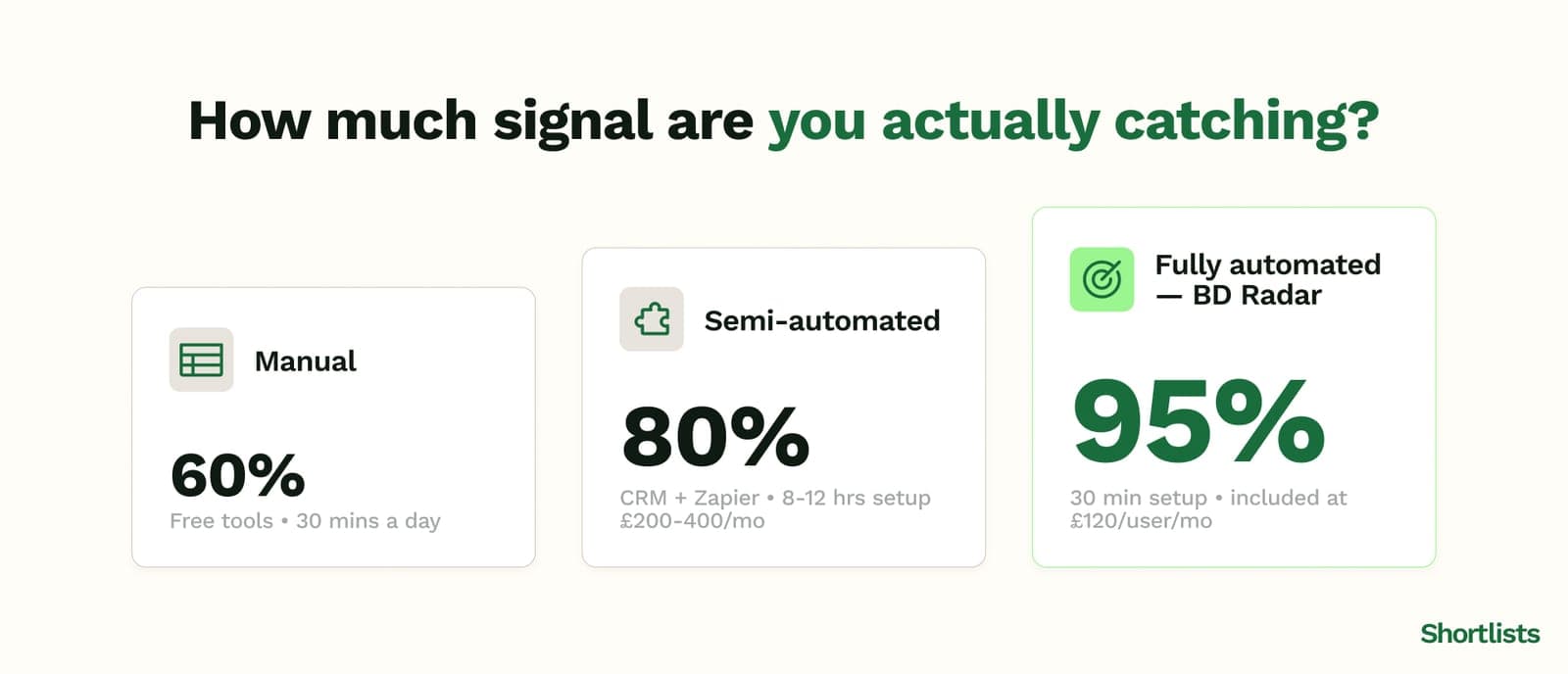
Reading signals is one thing. Doing it consistently is what produces results. Three setups, from manual to fully automated.
Manual setup
You can run a serviceable BD Radar with free tools and 30 minutes a day.
- Beauhurst free tier — UK funding signals
- LinkedIn Sales Navigator — VP movement, senior departures
- Google Alerts — company-name and funding-keyword alerts
- A spreadsheet — your target list, scored
Limitations: no automated scoring, no aggregation, no routing. You'll catch ~60% of the signals available to you.
Semi-automated
Combining signal sources into a CRM with scoring rules.
- Beauhurst paid + LinkedIn Sales Nav + Otta for signal capture
- Zapier or n8n for routing signals into your CRM
- Your CRM for target scoring, daily task creation, message templating
Setup time: ~8-12 hours. Catches ~80% of signals. Costs about £200-400/month all-in.
Fully automated — BD Radar in Shortlists
BD Radar (the feature inside Shortlists) aggregates all four signal types, scores companies by hiring probability, and routes high-score targets to your daily task list. No Zapier. No spreadsheet. No manual aggregation.
Setup time: ~30 minutes (target list + signal preferences). Catches ~95% of signals. Included in the standard $120/user/month — not a paid add-on.
The 30-minute daily routine that compounds
Whichever setup you choose, the routine looks the same:
- 5 minutes — check overnight signals. What fired since yesterday?
- 10 minutes — score the top 8 targets. Which are real? Which are noise?
- 10 minutes — write 3 first-touch messages. One per high-confidence target.
- 5 minutes — log + queue follow-ups. Anyone from 7 days ago that needs a nudge?
30 minutes a day. ~8 signals reviewed. ~3 messages sent. The compounding effect kicks in after 4-6 weeks. By month 3, a recruiter running this routine consistently has 2-3 active warm conversations per week from prospects who haven't yet posted a job. For the longer treatment, see the 30-min daily BD routine.
BD Radar in Shortlists — how it works
BD Radar is built into Shortlists as a standard feature, not a paid add-on. It aggregates the four signal types into a single feed, scores each surfaced company by hiring probability, and routes high-score targets to your daily task list with suggested next actions.
The scoring model weights signals differently:
- Funding rounds carry the highest weight (most predictable hiring outcome).
- VP-level hires + senior leavers carry mid-weight (depends on tenure and seniority).
- Adjacent posting volume carries variable weight depending on function-specific patterns.
You configure your target list (industries, geographies, company size bands) once. BD Radar runs continuously. Your daily task list shows the top 8-15 prospects with the strongest signals, refreshed overnight.
If that sounds useful, BD Radar product page has the detail.
BD Radar vs Loxo Account-Based Prospecting — the honest comparison
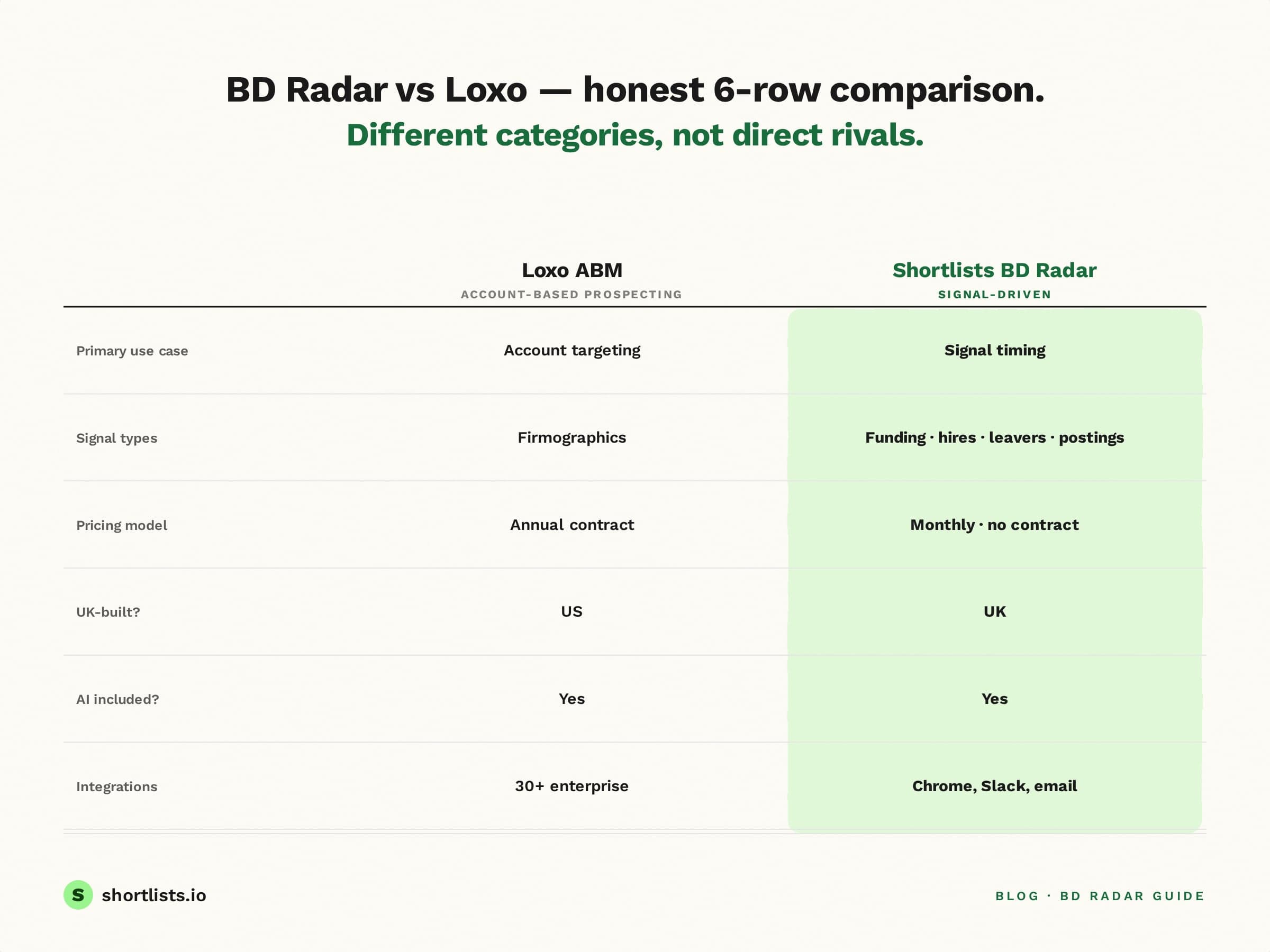
Loxo's account-based prospecting is the closest competitive feature in the recruiting CRM market. They're related, but they solve different problems.
Where they overlap
- Both surface target accounts likely to need hiring soon.
- Both integrate signal data into a CRM and task workflow.
- Both are intended for proactive BD rather than reactive job-board response.
Where they differ
- Loxo's strength is account targeting — identifying which accounts to focus on, often via firmographic and historical hiring patterns.
- BD Radar's strength is signal timing — identifying when to act on accounts, via leading indicators.
The two approaches can be complementary, but for a boutique UK agency they overlap enough that you'd pick one. Loxo if you're US-Anglo, larger team, account-list-first thinking. BD Radar if you're UK-focused, smaller team, timing-first thinking.
When to use which
- Loxo — if your bottleneck is which accounts to target. You have time but lack focus.
- BD Radar — if your bottleneck is when to act. You know your accounts but miss the timing windows.
Most small UK agencies hit the timing problem before the targeting problem. For the longer treatment, see BD Radar vs Loxo comparison.
Frequently asked questions
What is BD Radar in recruitment software?
BD Radar is a category of recruitment tool that surfaces hiring signals — funding rounds, executive hires, senior leavers, adjacent role posting volume — before roles are publicly advertised. It lets recruiters approach hiring managers 30-90 days earlier than competitors who rely on LinkedIn job posts.
How does BD Radar find fee-earning roles before they are posted publicly?
BD Radar aggregates four signal types: funding announcements (Crunchbase, Beauhurst), VP-level hires (LinkedIn movement), senior leavers (LinkedIn role-change tracking), and adjacent role posting volume. It scores each company by hiring probability and routes high-score targets to the recruiter's daily task list.
What is pre-job posting intelligence in recruitment?
Pre-job posting intelligence is the practice of identifying companies likely to hire before they publish the role. It uses leading indicators — funding, executive hires, departures, posting velocity — instead of lagging indicators like the job advert itself.
How can a recruiter know who is hiring before the job is advertised?
Track the four hiring signals: funding rounds (a £10-50M Series B usually generates 8-15 hires within 90 days), VP-level executive hires (a new VP brings 3-7 hires in 6 months), senior departures (70% are backfilled within 90 days), and adjacent role posting (5 mid-level posts in a function predict a senior role 60 days out).
What are the four hiring signals that predict a role before it goes live?
Funding rounds, VP-level executive hires, senior leavers, and adjacent role posting volume. Each signal works on its own; combined, they predict hiring intent with high accuracy 30-90 days before public posting.
How do recruiters find new clients before a job is posted on LinkedIn?
They watch leading signals instead of the LinkedIn jobs feed. Manual options: Google Alerts on company names, funding databases like Beauhurst, and LinkedIn movement notifications. Automated options: tools like BD Radar in Shortlists that aggregate, score, and route all four signal types to your daily task list.
Next steps
If you want to start manually this week:
- Set up a Beauhurst free-tier feed for your sector + UK geography.
- Add LinkedIn movement notifications for your top 50 target accounts.
- Block 30 minutes in your calendar every weekday morning for the BD Radar routine.
If you want the deeper signal mechanics:
- Read the 4-signal framework in detail.
- Read how funding predicts hiring.
- Read the 2-hour BD problem.
If you want it automated:
- See the BD Radar product page.
- See Shortlists pricing.
- Or skip the manual setup and book a 20-minute demo.
Last updated 29 May 2026. Signal patterns shift as the UK hiring market evolves — we refresh this guide quarterly. If a number or pattern here is out of date, tell us.